

Aicha Mounsif, Meaghan Hall and Ramon Wildgoose
Size polymorphism in the desert leafcutter ant Acromyrmex versicolor
Abstract:
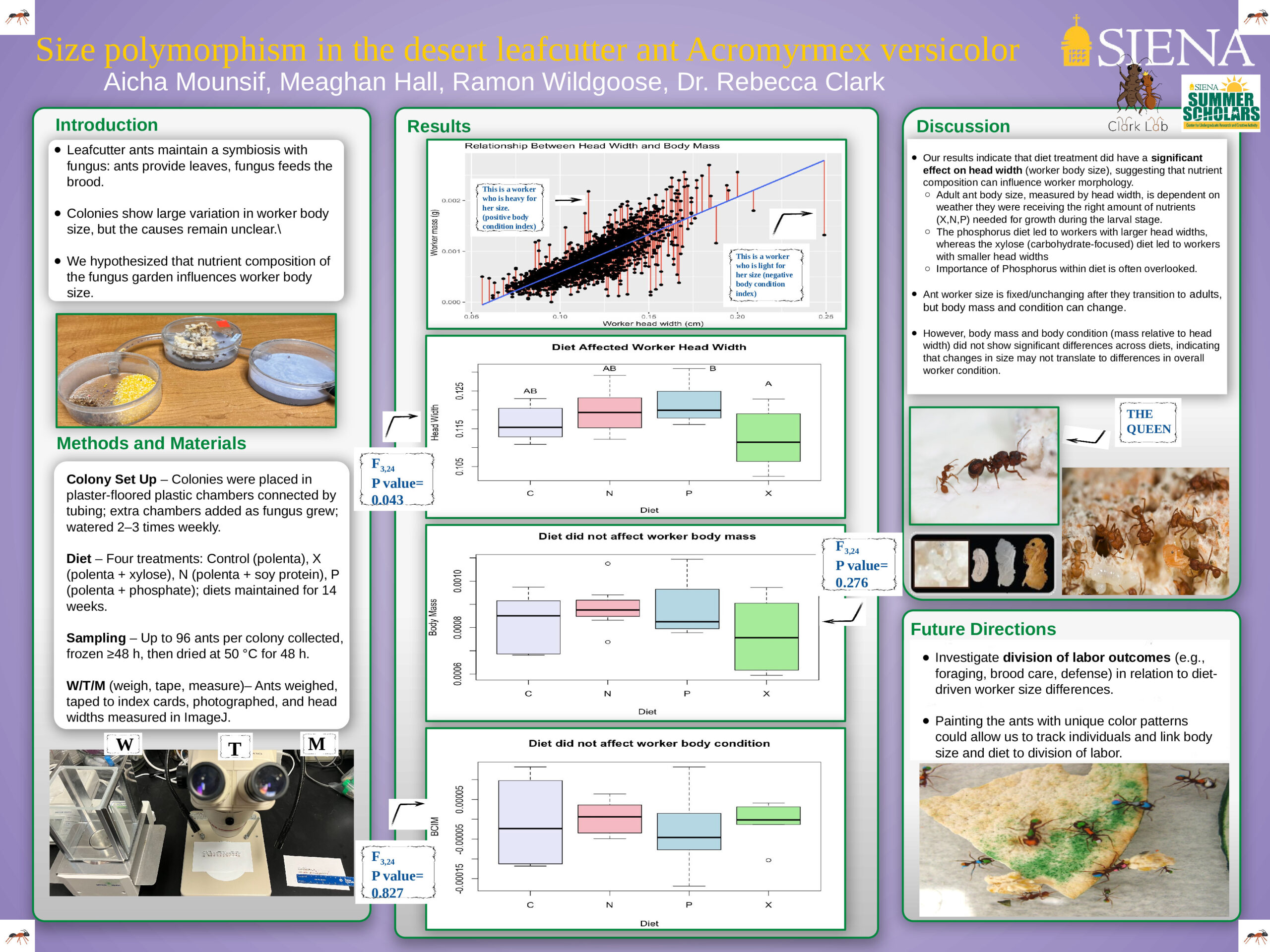
Leafcutter ant colonies function as complex adaptive systems, where individual ants cooperate to ensure survival and growth of the whole colony. The ants have a coevolved, symbiotic relationship with a mutualistic fungus, where the ants collect leaves to provision the fungus, facilitating its growth. In turn, the fungus serves as the sole food source for growing ants (brood) in the colony. While adult workers in leafcutter colonies can range dramatically in overall body size, there is much that we still do not know about patterns of body size variation and why size variation exists. We hypothesized that the nutrients fed to the fungus garden ultimately affect worker ant body size. We gave colonies of the desert leafcutter ant Acromyrmex versicolor one of four diets with different amounts of protein, carbohydrate, and phosphorus, and allowed the ants to forage and provision their fungus gardens for 14 weeks (n=20 colonies per diet). We then froze, dried, and weighed up to 96 workers from each colony, and measured their head widths. We plan to evaluate mean adult worker body size (head width) and body condition (head width relative to dry weight). Our findings will help us understand the extent to which adult worker body size can be influenced by their diet, to better understand the implications of body size variation in leafcutter ants more broadly.Title
Size polymorphism in the desert leafcutter ant Acromyrmex versicolor
Faculty Advisor
Dr. Rebecca Clark
Course
CURCA Summer Scholars
Location
Table 1