
Maria Barabash
Russia’s Disinformation Campaigns Against Ukraine
Abstract:
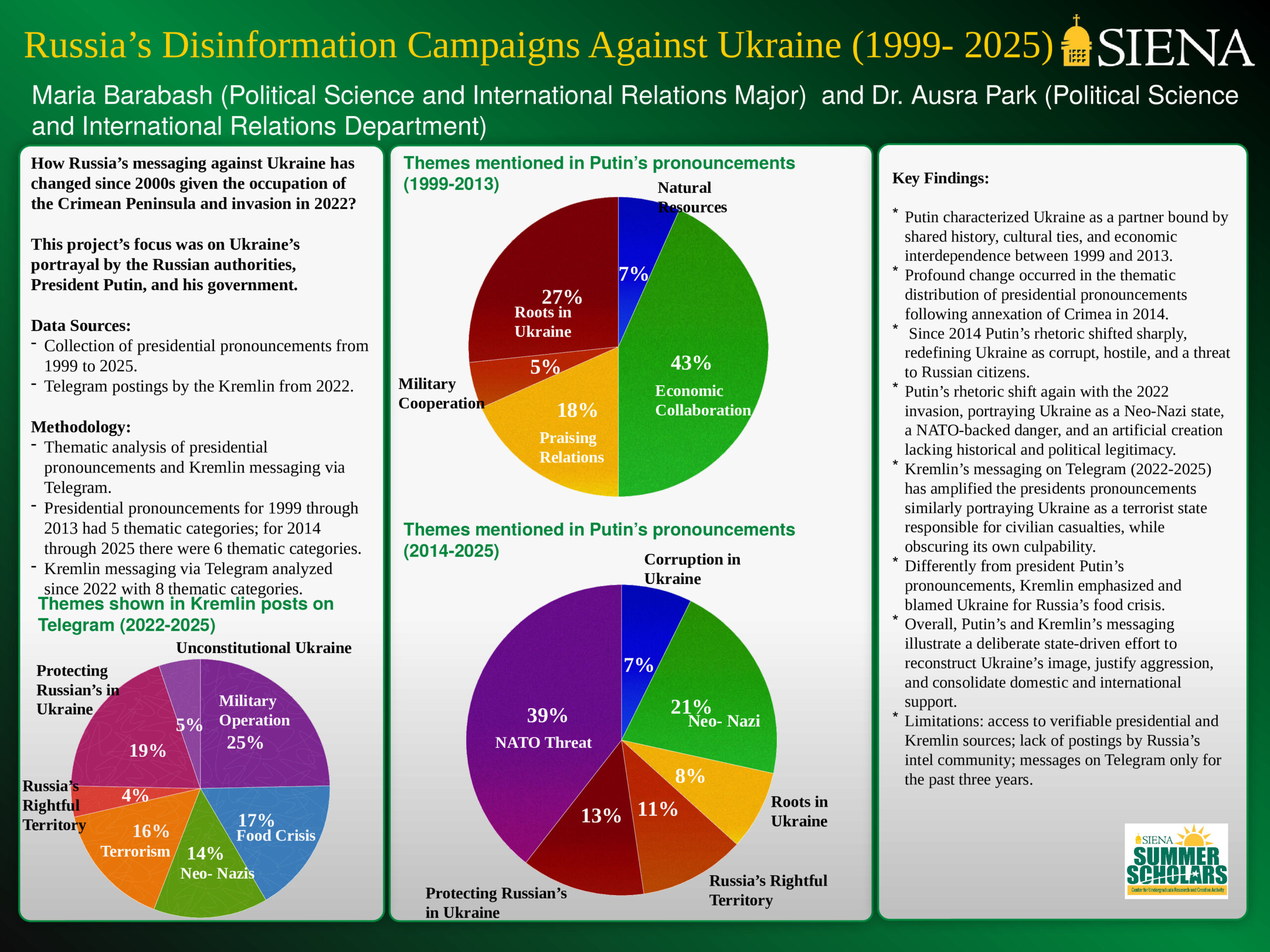
This project examines the evolution of Ukraine’s portrayal by the Russian state under Vladimir Putin, focusing on presidential pronouncements and Kremlin messaging via Telegram. From 1999 to 2013, Putin characterized Ukraine as a partner bound by shared history, cultural ties, and economic interdependence. Following the 2014 annexation of Crimea, however, his rhetoric shifted sharply, redefining Ukraine as corrupt, hostile, and a threat to Russian citizens—most notably those in Crimea. The 2022 invasion further intensified this transformation, with over 50 public statements framing Ukraine as a Neo-Nazi state, a NATO-backed danger, and an artificial creation lacking historical legitimacy. Parallel to these pronouncements, the Kremlin leveraged Telegram to amplify narratives portraying Ukraine as a terrorist state responsible for civilian casualties and even Russia’s food crisis, while obscuring its own culpability. Together, these discourses illustrate a deliberate state-driven effort to reconstruct Ukraine’s image, justify aggression, and consolidate domestic and international support. While this analysis is limited to verifiable presidential and Kremlin sources, it highlights how Russia’s information strategy has evolved from a partnership to enemy, revealing the central role of propaganda in shaping perceptions and legitimizing military action.Title
Russia’s Disinformation Campaigns Against Ukraine
Faculty Advisor
Dr. Ausra Park
Course
CURCA Summer Scholars
Location
Table 3