

Fasiha Khaliq and Shane Kirschmann
NMR Spectrometer with Arduino
Abstract:
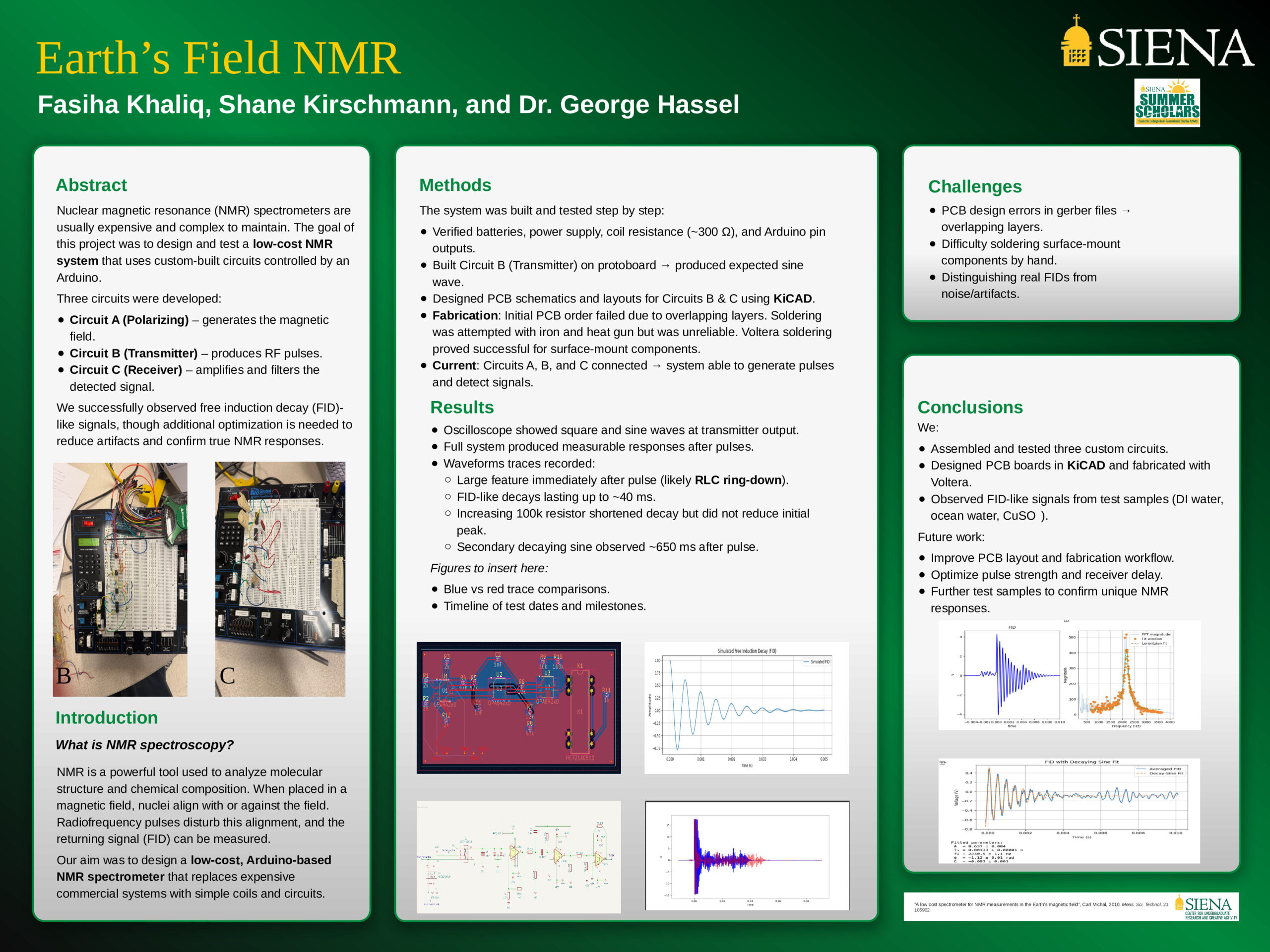
This project focuses on the design, construction, and testing of a low-field nuclear magnetic resonance (NMR) system using custom-built circuitry. The system consists of three main components: Circuit A (polarization and switching), Circuit B (transmitter), and Circuit C (receiver and signal conditioning). Individual circuits were prototyped, tested on breadboards, and later transferred to printed circuit boards (PCBs) designed in KiCAD. Circuit A successfully generated the polarizing field, Circuit B produced the expected RF pulses, and Circuit C amplified and filtered the received free induction decay (FID) signals. Testing with various samples, including deionized water, ocean water, and CuSO₄ solution, consistently produced measurable responses. The observed signals feature a strong initial transient, attributed to RLC ring-down following the RF pulse, followed by decaying oscillatory envelopes resembling FIDs with lifetimes on the order of tens of milliseconds. The implementation of surface-mount soldering techniques, including Voltera reflow, was key to assembling the PCBs. Preliminary results confirm the functionality of the integrated system and demonstrate its ability to generate and detect NMR-like signals. Future work will focus on refining receiver sensitivity, mitigating pulse ring-down effects, and comparing signal characteristics across different sample types.Title
NMR Spectrometer with Arduino
Faculty Advisor
Dr George Hassel
Course
CURCA Summer Research
Location
Table 3